The Waterfall Building
Arthur Erickson with Nick Milkovich Architects, 2001
A doorway beside the inlet.
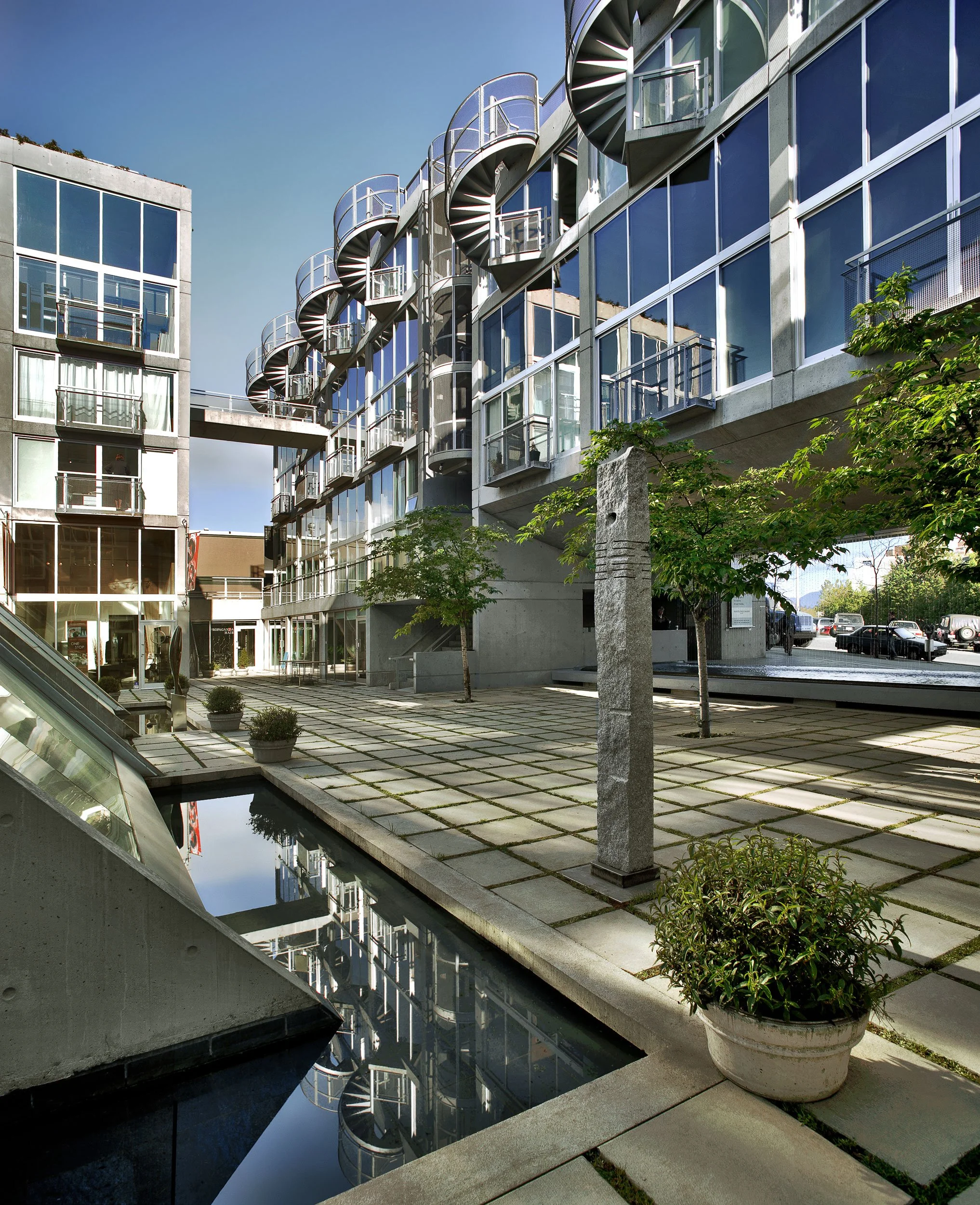
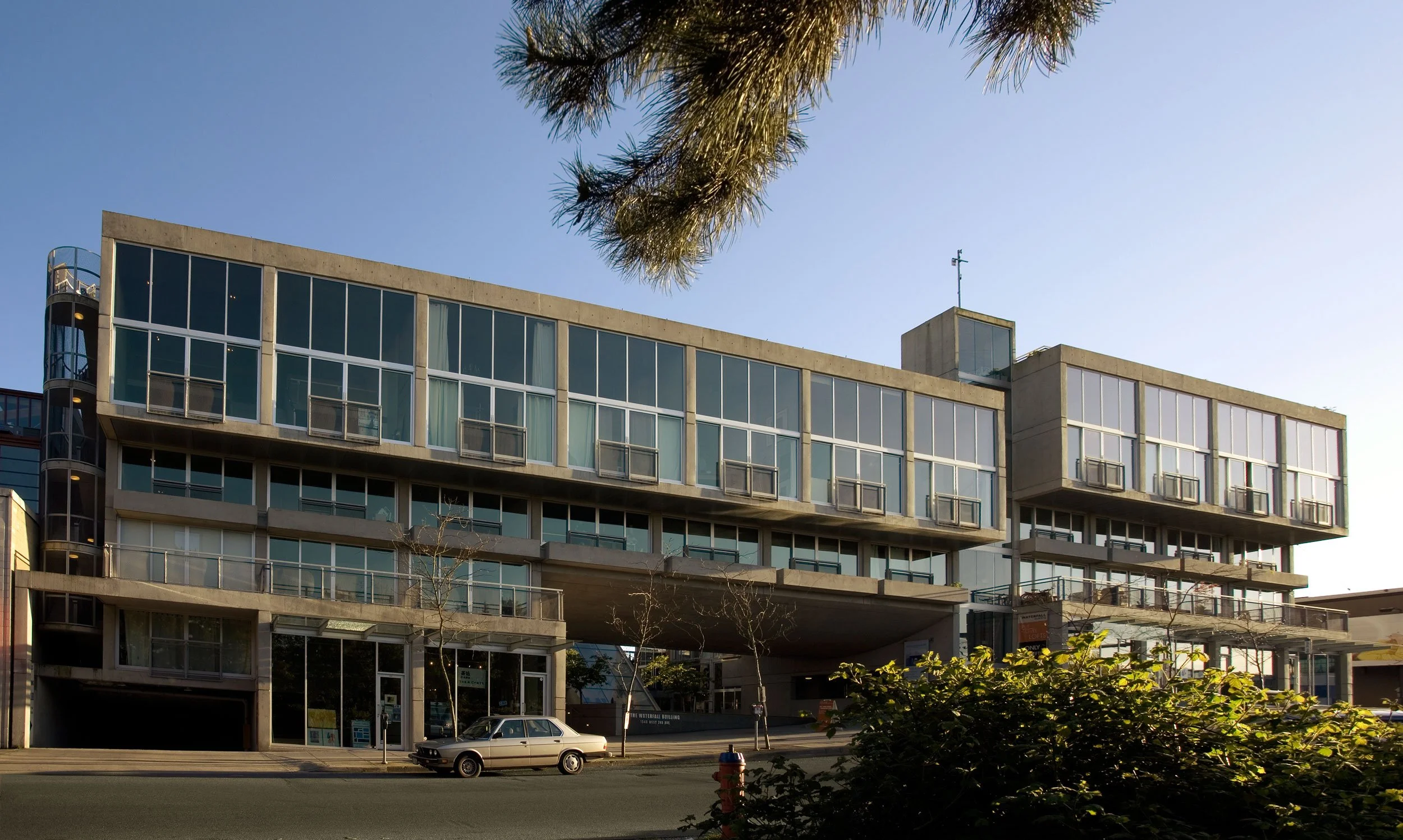
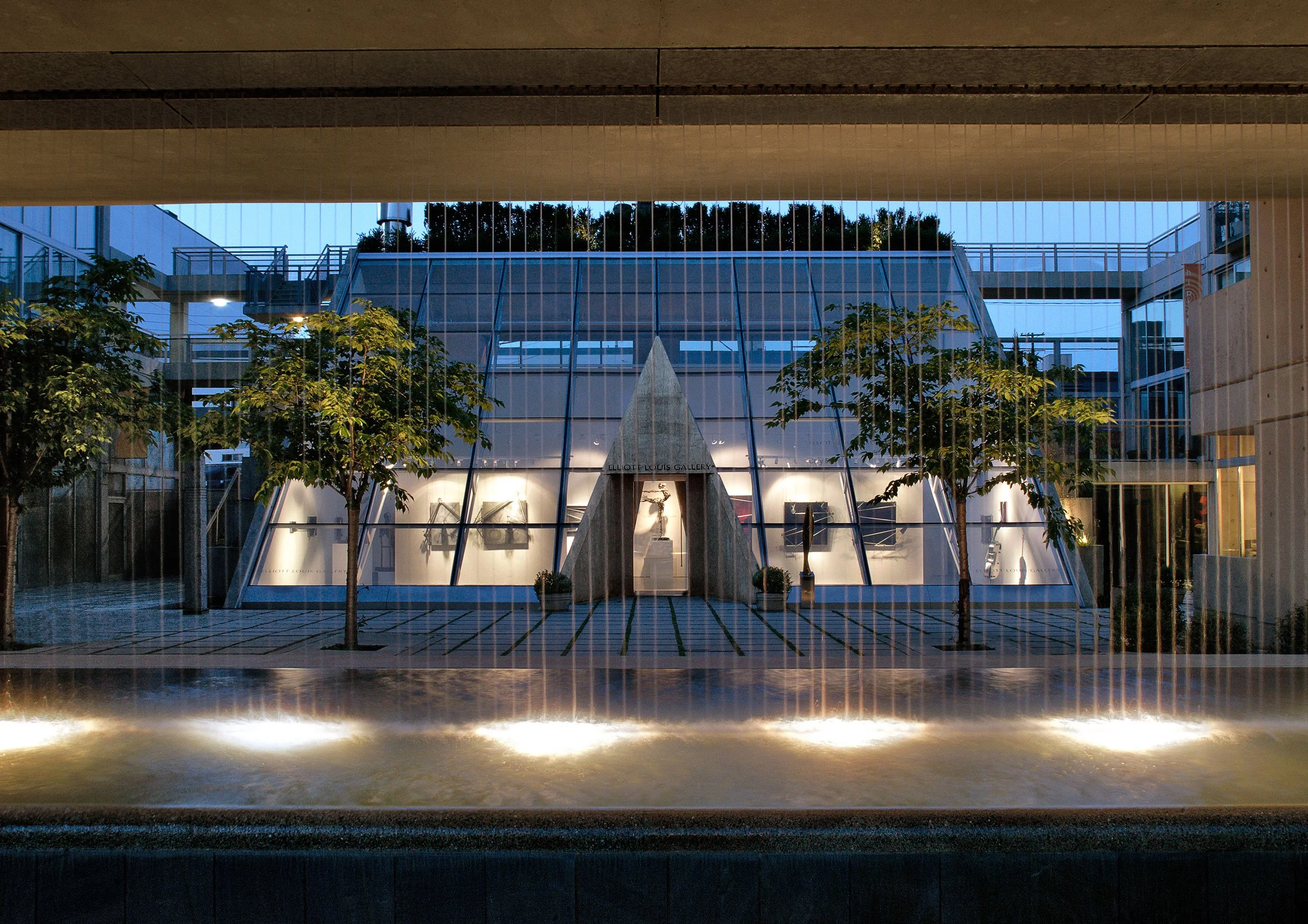
Set into the slope just east of the Granville Island bridge, the Waterfall Building turns its back on no one. From the street, an opening sixty-five feet wide cuts through to a courtyard. A curtain of water falls from the curved underside of a concrete bridge into a shallow reflecting pool. The sound buffers the city. The light bounces up. You are already inside before you have stepped past the threshold.
Arthur Erickson, 1924 to 2009.
Erickson built a way of seeing the West Coast in concrete. Simon Fraser University on Burnaby Mountain. The Museum of Anthropology at UBC. Robson Square. The Canadian Chancery in Washington. He treated buildings as landscapes and landscapes as architecture, and he insisted on the dignity of the material in front of him.
The Waterfall Building, designed in 1996 with longtime collaborator Nick Milkovich and completed in 2001, sits near the end of that arc. It is one of the last works Erickson saw finished. A small project, sixty-five thousand square feet, but a clear one: courtyard, water, light, and the slow self-effacement of concrete left to weather.
"The other important concept was to engender a community spirit. That is why all the units are grouped around a south-facing, light-filled inner courtyard that is private, but connected to the street."
Stephen Hynes kept the waterfall.
Stephen Hynes was educated as a philosopher. Then he became a Vancouver developer, founded Hillside Development, and in the mid-nineties he commissioned Arthur Erickson and Nick Milkovich to design a live-work building on a sloped lot near the Granville Island bridge.
When the structural engineers ran the numbers, they came back with a savings of one million dollars. All Hynes had to do was replace the long-span concrete bridge and its forty-foot curtain of water with a single column on a foreshortened bridge. The waterfall was, by every conventional measure, an indulgence. He kept it.
That decision is the reason the building has its name, its sound, and its threshold. The bridge spans nineteen and a half metres and carries one point one million kilograms of concrete, eight live-work studios, and four rooftop gardens above the entry. The water falls beneath it on schedule. None of this is necessary. All of it is the point.
Three ideas, held together.
Light.
Every studio reaches sixteen feet to the ceiling. Sliding doors open onto French balconies. Each unit looks in two directions, courtyard and city, and breathes through both.
Community.
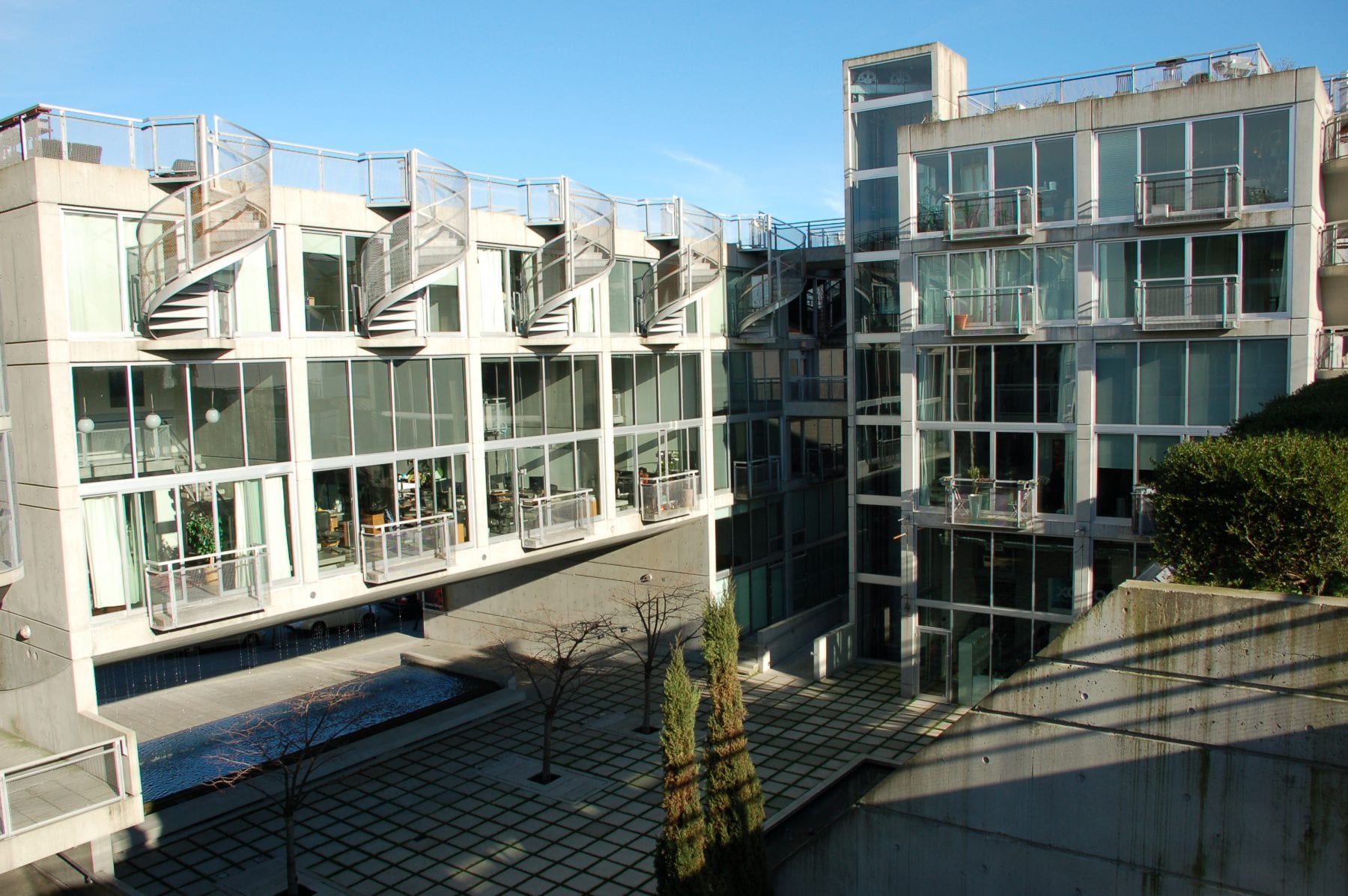
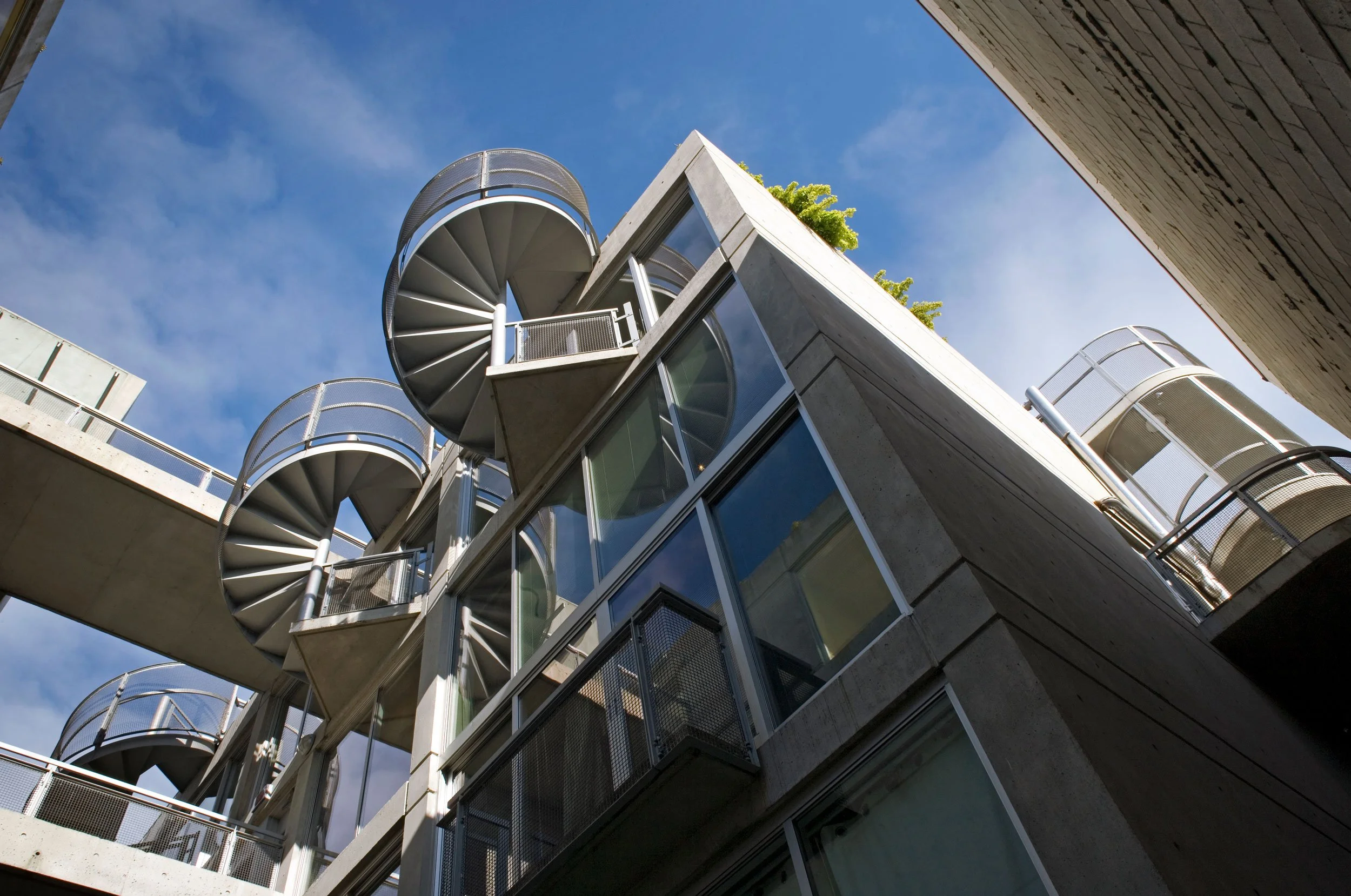
Forty-nine live-work studios gather around one south-facing courtyard. The street opens into it. Glass elevators climb to landscaped roof terraces. Nothing here is hidden behind a lobby.
Material.
Sandblasted concrete left exposed. Galvanized and stainless steel. Steel mesh. Polished concrete floors over radiant heat. The finishes are robust because the spaces are meant to be used.
Forty feet of water, falling on schedule.
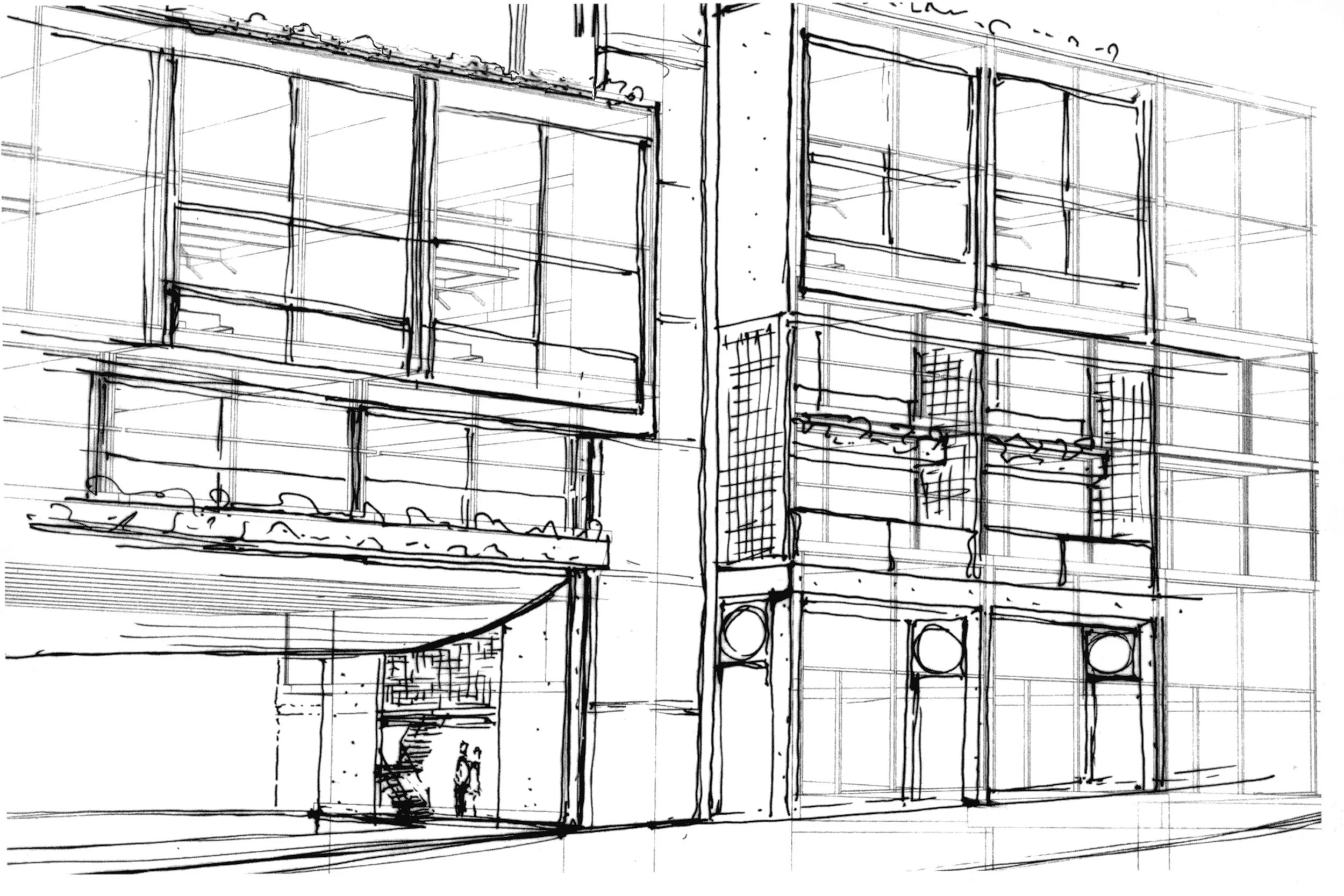
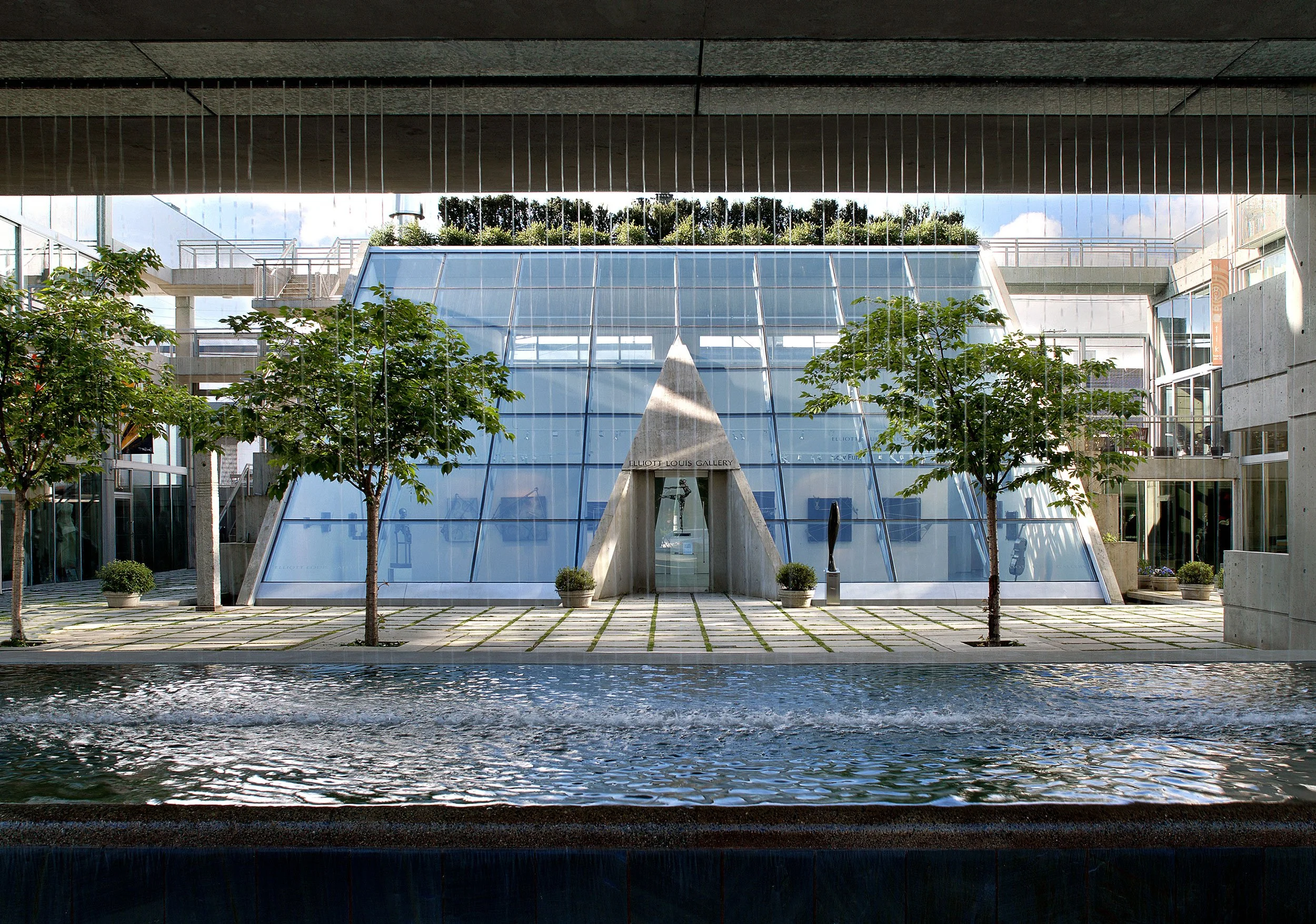
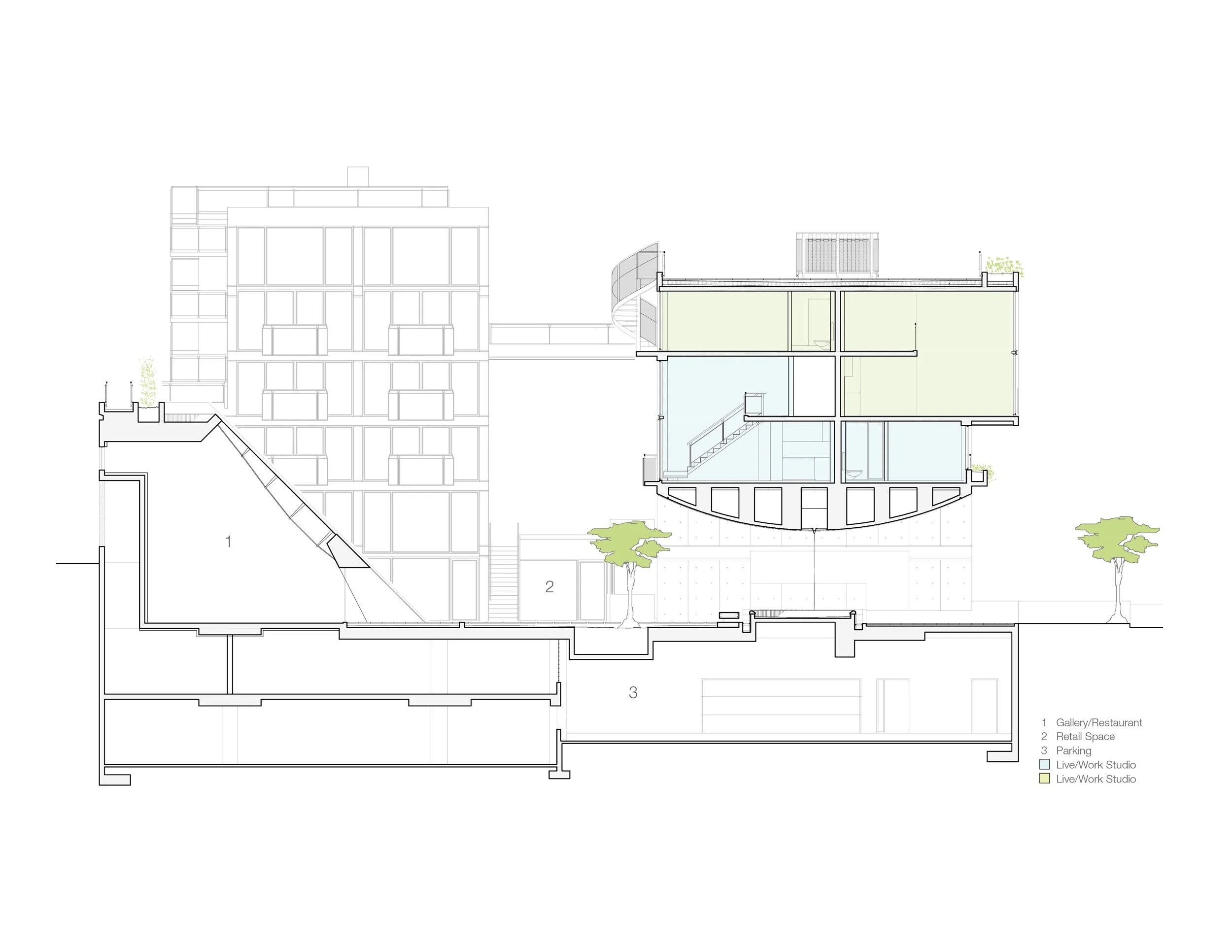
A nineteen and a half metre clear-span concrete bridge crosses the entrance, suspending three storeys above the courtyard floor. From the curved underside of the bridge, a fluid screen of water descends forty feet into a shallow reflecting pool. The engineering brief was difficult: a bridge that looks light while carrying the weight of three concrete storeys, with glazed facades free of shear walls or diagonal bracing.
Fast + Epp's solution was a site-cast cellular post-tensioned concrete deck with a circular soffit, one point eight metres deep at the centre line and tapering to four hundred millimetres at the edges. The transverse shear walls balance over the stiff centre ribs. The bridge carries one point one million kilograms of concrete, eight studios above it, and four rooftop gardens. The water came later, designed by Vincent Helton, and it does two quiet things at once: it screens the courtyard from street noise, and it lifts reflected light up into the bridge above.
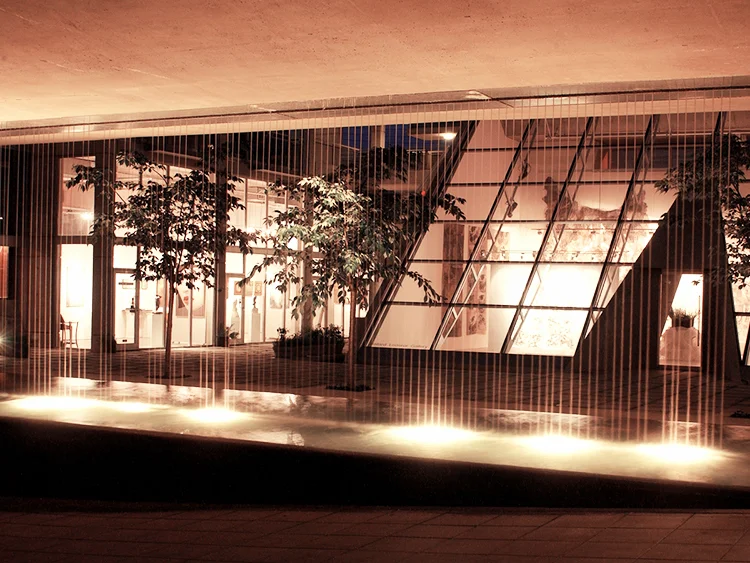
A glass wedge, a moss garden, white roses.
Directly across from the street opening, a glazed wedge-shaped pavilion rises from the courtyard floor, its sloped front catching the southern light. Originally an art gallery, it now houses the restaurant Ellipsis. Four live-work studio blocks and the glass restaurant pavilion enclose the courtyard. The sides are planted with white roses that tumble down toward the ground. Between concrete pavers, deer ferns and moss gardens take hold. A few cherry trees mark the seasons.
Two glass elevators climb from the courtyard to landscaped roof terraces, where the view turns north toward the inlet and the mountains beyond. The architect called the courtyard private but connected to the street. In practice that is exactly what it is: a room with one wall missing, by design.
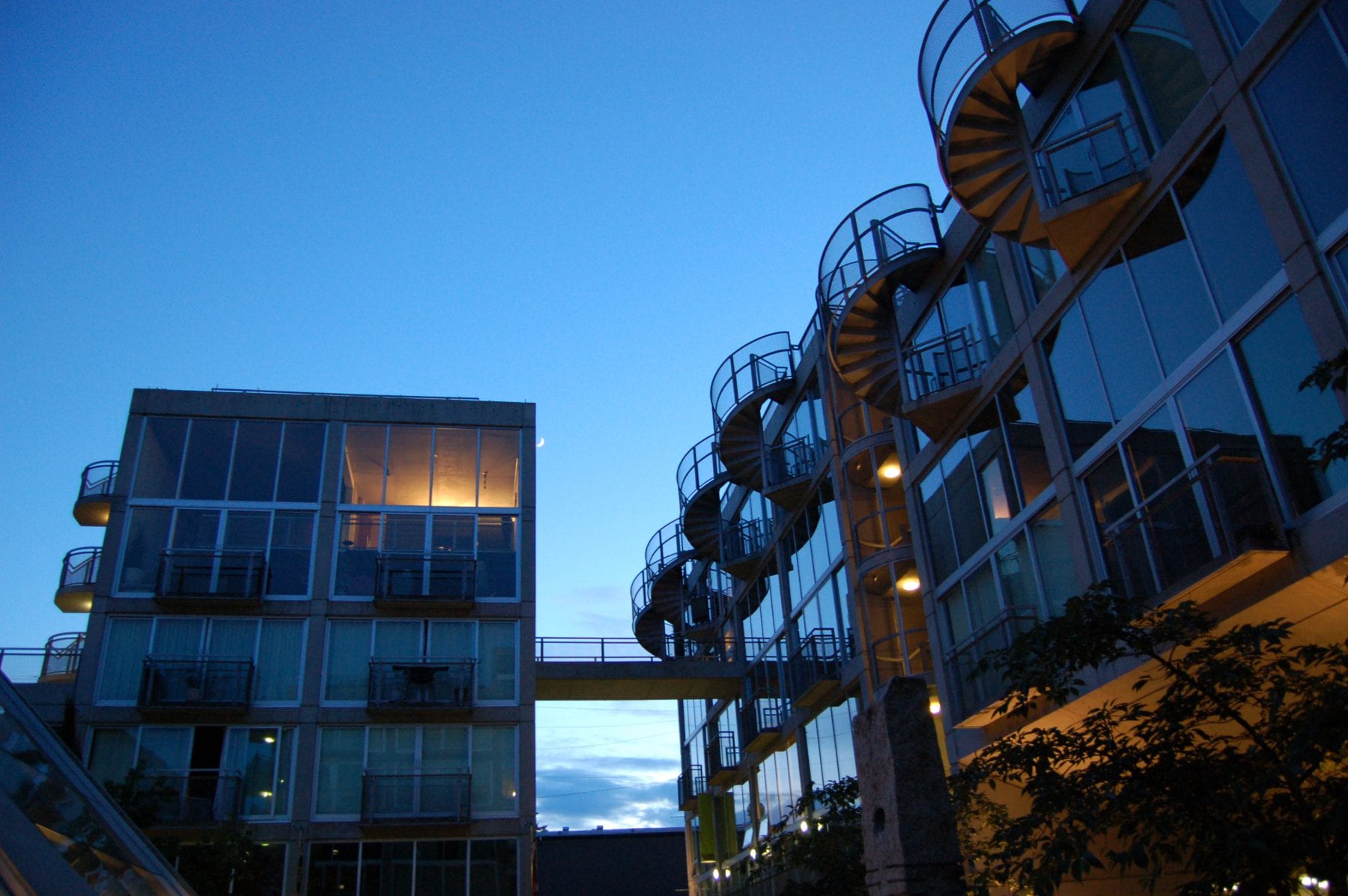
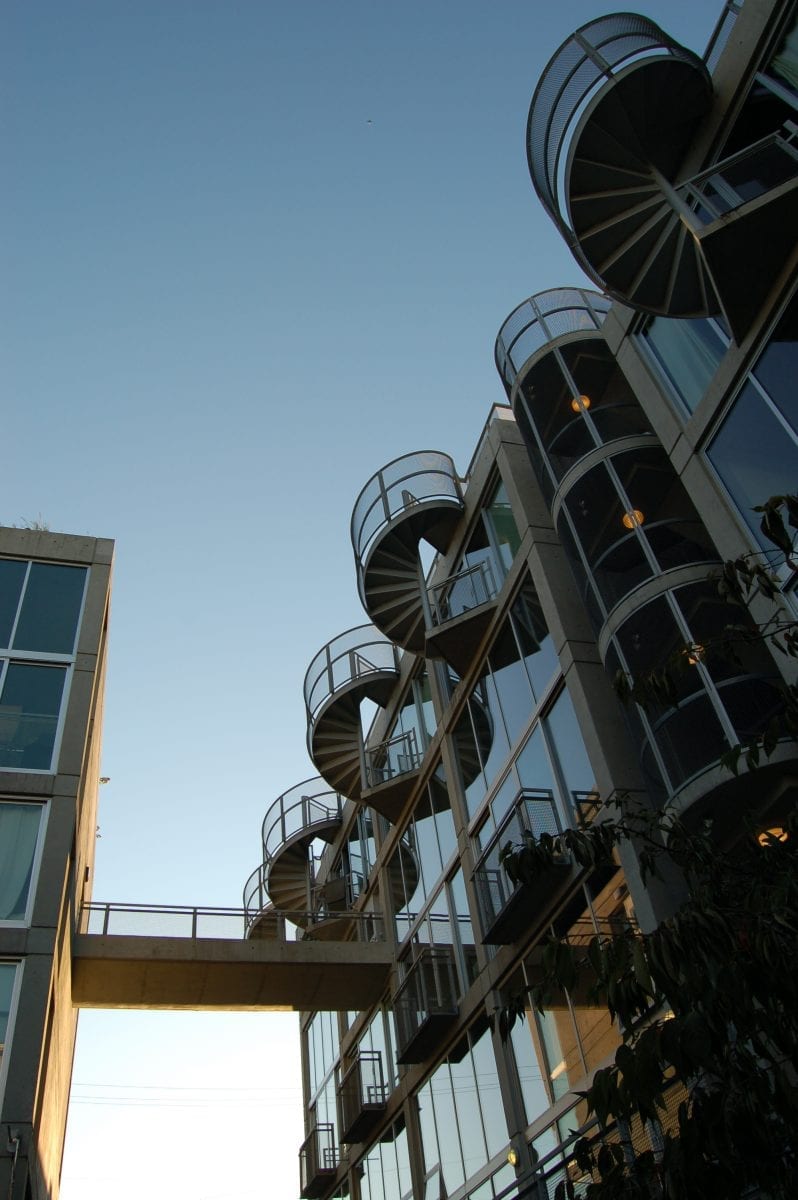
Robust, by intention.
- Ceiling Height
- 16 ft, fully glazed
- Walls
- Sandblasted concrete, left exposed
- Floors
- Polished concrete over radiant heat
- Hardware
- Galvanized steel, stainless steel, steel mesh
- Doors
- Sliding to French balconies
- Ventilation
- Through-ventilation, north/south or east/west
- Parking
- Two levels below grade
- Blocks
- Four live-work studio blocks and a glass restaurant pavilion, around one courtyard
The studios were never finished. They were prepared. A blank palette in concrete and steel for the people who would live and work in them to make their own.
The building, observed.
How the building was made.
Photography courtesy of Nick Milkovich Architects, Fast + Epp, and Vincent Helton & Associates. This is an unofficial tribute site. No commercial use of imagery is implied. With gratitude to Stephen Hynes, who kept the waterfall.